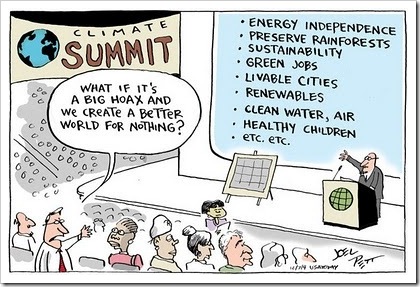
Oh, so true.


 Dan
Dan Oh, so true.
Last week, I saw Avatar at our local theater in 3D. It wasn’t an IMAX theater, so the 3D technology was RealD. Yesterday, I saw it at an IMAX theater in 3D. I’m not sure if it was projected using a different 3D technology or not, but I did notice a significant difference between my first viewing in a regular 3D theater.
The first thing I noticed was that the glasses were different. In the RealD theater, the glasses come individually wrapped and they look very much like normal sunglasses (cheap ones, but normal) with hard plastic lenses. The glasses in the IMAX theater were larger, cheaper glasses with dark plastic film lenses. One of my friends had to exchange his because they were badly smudged, which makes me wonder if the glasses are just tossed the back in a bin after the movie without being checked or cleaned. The glasses reminded me of the kind you’d find at a 3D show at Hershey’s Chocolate World or a Disney park. I was worried because I’ve had bad experiences in those theaters.
Once the movie started, I was glad to see that the 3D effects looked perfect. The images were crisp and the depth was exactly as expected. I had no trouble focusing on the 3D without any visual freak-outs (that’s the technical term).
What was significantly different was the brightness of the image. I don’t know if it was the theater or if it was the 3D technology or my seat location, but the IMAX image was much darker than the image in the normal theater… like viewing a movie while wearing sunglasses. Some of the finer image detail was lost.
Again, I don’t know if it was the 3D technology or some other factor, but viewing the movie in a normal theater using RealD technology was a better experience for me. The brighter image (like a normal movie) really brought out small details in the image that enhanced the movie for me.
Now, just to clarify… the IMAX experience was also awesome. The movie is visually spectacular (bright or not) and the story is good, so it’s an easy movie to love and I’d be happy to go see it a third time if the opportunity presents itself. Given the choice, however, I’d go to a normal RealD theater.
Actually, given the choice, I’d go to Pandora.
 Looking for an exceptionally worthwhile charity to support this year? Check out the Foundation Beyond Belief, which is officially launching today. Founder Dale McGowan, the author of Parenting Beyond Belief and Raising Freethinkers, started Foundation Beyond belief with the following goals.
To demonstrate humanism at its best by supporting efforts to improve this world and this life; to challenge humanists to embody the highest principles of humanism, including mutual care and responsibility; and to help and encourage humanist parents to raise confident children with open minds and compassionate hearts.
The Foundation features ten charitable organizations each quarter focusing on a number of different areas such as health, education, poverty, child welfare, human rights, etc. When you join and contribute, you determine where your contribution should go (among the ten charities for that quarter). At the end of the quarter, all the donations are distributed and a new set of charities is selected. More information can be found at the Foundation’s About page.
Here are a few details.
Here’s the Foundation’s introductory video as well.
Consider the Foundation Beyond Belief for your charitable donations. You’ll be supporting great causes and, as Dale’s mission statement says, demonstrating humanism at its best.
Via The Intersection blog, Chris Mooney made me aware of a great brochure (pdf) from NOAA, the National Oceanic and Atmospheric Administration, that gives some basic climate science literacy information. It’s a great introduction to the multifaceted complexities of climate science, how climate works, how it’s measured, and how humans effect it.
It starts out with a great definition of a “climate-literate person.”
A climate-literate person:
- understands the essential principles of Earth’s climate system
- knows how to assess scientifically credible information about climate
- communicates about climate and climate change in a meaningful way
- is able to make informed and responsible decisions with regard to actions that may affect climate.
It continues with information about why climate science literacy matters (and why science literacy in general matters), how climate science is an ongoing process, and how we can know what is scientifically correct.
The main points explained in the brochure are the following:
CLIMATE LITERACY: The Essential Principles of Climate Science
- The Sun is the primary source of energy for Earths climate system.
- Climate is regulated by complex interactions among components of the Earth system.
- Life on Earth depends on, is shaped by, and affects climate.
- Climate varies over space and time through both natural and man-made processes.
- Our understanding of the climate system is improved through observations, theoretical studies, and modeling.
- Human activities are impacting the climate system.
- Climate change will have consequences for the Earth system and human lives.
There’s plenty of detail for each point given and the explanations are clear, giving a solid foundation for learning more about climate science and actually understanding the climate issues that are affecting (and will affect) our lives.
Chris Mooney wonders…
But anyway, it is interesting to contemplate whether climate “skeptics” take issue with any of these basics, or whether they are indeed “climate science literate” by this standard. For after all, the complicated data and “hockey stick” type issues that “skeptics” seem to seize upon don’t appear to have much to do with these basics; and yet these basics are all you need to know that global warming is a serious concern and that we stand to get fried.
(ed. …and by “skeptics” he means “deniers”… hence the sarcasm quotes)
I’ve heard and read plenty from deniers who plainly lack a basic understanding of the science and who enthusiastically ride the denier bandwagon regardless of where it leads… whether it’s something as silly as offering a big snowstorm in Montana as evidence against global warming, using a few out-of-context comments by some climate scientists to decry the state of scientific research, or claiming that a lone scientist with a new way of looking at data has overturned decades of climate research. The bandwagon in question is propelled by politically-created excrement.
Here’s one of my favorite parts from the brochure.
CLIMATE SCIENCE LITERACY IS A PART OF SCIENCE LITERACY.
“Science, mathematics, and technology have a profound impact on our individual lives and our culture. They play a role in almost all human endeavors, and they affect how we relate to one another and the world around us. . . . Science Literacy enables us to make sense of real-world phenomena, informs our personal and social decisions, and serves as a foundation for a lifetime of learning.”
From the American Association for the Advancement of Science, Atlas of Science Literacy, Volume 2, Project 2061.
The fruits of science are all around us, yet the state of science literacy in our country is horrifyingly low. Not only do we have people who don’t understand science or how it works, but we have the much more harmful group of people who think they understand how science works and who think they have an understanding of scientific issues, but are hopelessly lost in an ideological quagmire created by politics, religion, or other insidious cultural influences.
Climate science denialism is a perfect example of how anti-scientific ideology mucks with the real issues in ways that will create tangible consequences. It’s not just a matter of philosophical differences (you go your way and I’ll go mine). It’s a matter of the actual, physical consequences of promoting actions (or non-actions, as the case may be) that would lead to the degradation of our environment (you can’t go your way and I can’t go mine… since you borked it all up, thank you very much).
There is no “your way” and “my way” when it comes to the habitability of this planet. There’s simply an “our way” because just like the anti-intellectual, anti-science deniers, I’m stuck on this planet. It’s my home. It’s where I keep my stuff. It’s where all my friends and family live. It’s where my daughter lives and will continue to live after I’m gone.
The anti-science crowd puts lives at risk. They put our country at risk. They put our world at risk. Whether it’s the climate science deniers, anti-vaxxers, homeopathy pushers, or the myriad of other pseudo-scientific proponents, it all boils down to a lack of understanding of (or a deliberate rejection of) science.
…and that affects us all.
Homer’s reaction pretty much sums up the climate change denialists’ behavior.
http://www.youtube.com/watch?v=_7nv8iDZ_-0
(via)
(This was written back in November of 2001, about 7 months after my daughter was born.)
 Becoming the father of my daughter was a pretty big moment in my life. Ok, that’s an understatement. It was the big moment in my life, and the great thing about it is that it continues to be the big moment in my life. Becoming a parent gives you a wonderful perspective change regarding your life and the lives around you. I supposed it’s not so much a change as an expansion. It’s the one thing that I didn’t expect before my daughter Megan was born.
I watch her grow up and it’s both too fast and too slow at the same time. Too slow because I want to be able to talk to her and run around the yard and take her hiking in the park, but she’s only 7 months old. Too fast because she’s so much bigger than she was 5 months ago and she’s no longer content to just angelically lie in my arms and watch the ceiling fan spin. She wants to explore, crawl, climb, chew, and catch the cats. It’s a Catch-22 situation, as most parents know.
I picture her as she gets older… eyes wide as she comes downstairs on a Christmas morning, playing with the garden hose on a summer day, getting her first bike, dressing up for Halloween, first day of school, birthday parties, sports, family vacations, boyfriends (!!!), proms, college, getting married… ok, hold on. That’s the one that really gets me. Getting married. Giving my little girl away. Walking her down the aisle in her spectacular white dress and handing her over to some guy standing there in a tuxedo with a dazed look of adoration on his face. She’s just a baby, for heaven’s sake! She’s only 7 months old!
This thought hit home a few weeks ago when I saw the movie “Father of the Bride” with Steve Martin and Diane Keaton. As his daughter is getting married, the scene shows him remembering all the things his daughter did as she was growing up… coming downstairs wide-eyed on a Christmas morning, running in the yard, playing basketball, showing off her new prom gown… all the things that I, as a new father, picture Megan doing from the other end of the timeline. I was watching the screen, seeing Megan’s future past, pass before Steve Martin’s eyes.
I’d seen that movie at least once before, but I never saw it through a father’s eyes. I never felt the knot that formed in my stomach as I thought about “giving away” my daughter… never felt the panic of not being able to say goodbye before she left on her honeymoon… never felt the sad joy of receiving a phone call a few hours later so she could tell me she loves me. I never needed to wipe my eyes, either.
I don’t know if it will actually happen that way. I don’t know if any of the things I picture Megan doing as she grows up will occur as I imagine them. It doesn’t really matter. What matters is that I get to be there to watch my little girl grow up. I get to see the wide Christmas eyes, hear the giggling, taste the dry, crumbling Easy-bake oven cookies, smell the wildflowers she picked in the park, and feel the love that won’t go away.
…even after she walks down the aisle in her white dress.
I saw this months ago, but listened to it again and wanted to share it.
Tim Minchin performs his beat poem titled “Storm.” Don’t let “beat poem” put you off. This is such a wonderfully entertaining, funny, and insightful nine minutes that you won’t regret it!
From Obama’s Nobel acceptance speech (emphasis mine)…
The promotion of human rights cannot be about exhortation alone. At times, it must be coupled with painstaking diplomacy. I know that engagement with repressive regimes lacks the satisfying purity of indignation. But I also know that sanctions without outreach — and condemnation without discussion — can carry forward a crippling status quo. No repressive regime can move down a new path unless it has the choice of an open door.
Thanks to M. Duss at the Wonk Room for pointing out the highlighted text. Duss says about the highlighted bit…
That’s a wonderfully succinct description of the simplistic and destructive ideology that drove George W. Bush’s foreign policy, and which Bill Kristol is still trying heartily to convince himself and others hasn’t been discredited. This isn’t to say that Obama hasn’t retained some troubling elements of Bush’s national security policy, which progressives will continue to challenge and debate. But I think it’s hugely important to recognize that the key foreign policy conceit of the Bush years, the idea that America is in an existential struggle with a monolithic, undifferentiated Islamofascist other, has been discarded. And America — and the world — is safer for that.
I’ll go a step further and say that it applies to many of the “Tea Party Patriots” and their vitriolic outrage toward anything and everything surrounding Obama, non-Christian religions, homosexuality, abortion, and a number of other issues. Their arguments and manufactured controversies, mostly vapid, provide for them the “satisfying purity of indignation” that rational thinking and critical analysis do not.
Hardly befitting someone claiming to be a “patriot.”
The “ClimateGate” email “scandal” about climate change reminds me very much about the manufactured controversy about evolution and Charles Darwin. How so?
In the case of evolution, deniers will frequently make accusations that Darwin was racist, or misogynistic, or anti-Semitic as “evidence” that evolution by natural selection is unreliable (or untrue). Whether those claims about Darwin are true or not is debatable, but even if they were all true, it has zero effect on the validity of the theory of evolution by natural selection.
Scientific theories are based on facts, not the personalities of researchers.
With “ClimateGate,” deniers focus on a small number of cherry-picked, old emails from a few climate scientists, take them out of context, twist (or misunderstand) their meanings, point out some crankiness on the part of the scientists, and claim that they somehow debunk and discredit decades of climate research and mountains of evidence compiled and analyzed by hundreds (or thousands?) of other climate scientists.
It’s absurd thinking of the highest degree.