
Megan and I did some LEGO stop action work yesterday. And when I say “work” I really mean “play.” It was a good project for the first day of summer.
 Dan
Dan
Tilley T4 versus Montecristi Panama
 I’m at my brother-in-law’s house in Florida winding down from a Disney vacation and was musing about my choice of headwear for the trip. Those who know me know that I’m almost never without a hat… not a cap, but a hat. Generally, I wear a fedora of some sort, but always a hat with a brim that goes all the way around.
Since it’s summer, all my felt hats have been put away in storage and (almost) all my straw hats are out for the wearing. Montecristi Panama hats are my preferred headwear in the summer since they provide sun protection, are lightweight, and look good whether the situation calls for casual or dressy.
They are, however, not good in the rain. Since the weather forecast in Florida at this time generally includes an afternoon rainshower, I decided to take my Tilley T4 hat instead of one of my Montecristi Panamas because it can get soaking wet with no ill effects.
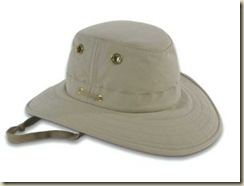 Other than its water indifference, the Tilley also provides better back-of-the-neck sun protection than most of my Montecristis, so overall, it was probably a pretty good choice. What I did notice, however, is that the Montecristis are signficantly cooler (from a temperature standpoint) than the Tilley. Cotton duck versus toquilla straw evidently makes a big difference.
Not that the Tilley didn’t serve me well, but as it turns out, we didn’t get caught in a single rainstorm the entire trip, so my concern about ruining a hat ended up being a moot point. So I sweated a bit more, but got better sun protection on my neck.
Generally speaking, I’ll pick a Montecristi over any other hat in the summer unless I’m doing something that will potentially beat the crap out of it. The Tilley is perfect for just such cases.
It’s all about the tradeoffs.
BP Spills Coffee
UCB Comedy has a great sketch mocking BP for their oil spill and impotent and feeble attempts to stop the leak.
On the Rail Trail
 Megan and I went for a bike ride on the rail trail today. Last time we went, we only went about two miles (if that) and she was all tired out. This time, the situation was reversed… majorly.
Megan has been riding around the neighborhood a lot lately, up and down our hills… for hours with her friends. I, on the other hand, have not. We went about nine miles and she would have gone farther, but after we hit the 4.5 mile marker on our way out and she said, “Should we go to the next one?” I declined, so we turned around and headed back to our starting point to complete our nine-mile “out and back” ride.
For those who know me, nine miles of bike riding is practically unthinkable for me… at least for the past decade or so. For Megan, it seems that it’s no longer a big deal.
I think that’ll be good for me.
The Greatest Show on Earth
 This past Sunday, May 31st, Lori, Megan, and I went to the Ringling Brothers Barnum & Bailey circus. For Megan and me, it was the first time ever. Lori had been to one before, but it was so long ago (and so far gone from memory) that it didn’t really count, so for all practical purposes, it was the first circus for all of us.
It was Barnum’s “Funundrum” show and it was spectacular. At one point, I looked over at Megan and she was sitting there with her mouth hanging open in amazement. It was awesome.
One thing that was really surprising to me was that their clowns were not creepy… not even close. We’re talking less creepiness than even Ronald McDonald, and he pretty much sets the standard for non-creepy clowns.
There was so much going on all the time that it was tough to actually take pictures and watch at the same time. It was also hard to take pictures at all because nothing ever stops moving and the lighting is usually a bit low. I managed to do okay, though, and got some decent shots.
That said, here’s a link to my full album of shots.
Splice… What’s the worst that could happen?
 Ever since I saw the trailer for the movie Splice, I’ve been looking forward to its arrival. It’s been on my calendar with the appropriate emailed reminders.
Well, I just got back from seeing it and, in my opinion, it was well worth the wait. Adrien Brody and Sarah Polley were believable and each played the necessary emotional range with skill and clarity… which is probably what made the movie so engaging.
Brody and Polley play Clive and Elsa, two genetic scientists specializing in gene splicing. They’ve created a couple unique creatures that produce a protein used to treat diseases in livestock and have earned an almost rock-star reputation within their company. When the company threatens to shut down their operation (for reasons left out of this review so as not to spoil anything), they decide to wade into the land of questionable ethics and use human DNA in their next (secret) splicing project… just to see if they can.
 As expected, things get out of hand and the ensuing interactions between Clive, Elsa, and Dren (the "creature," played brilliantly by Delphine Chaneac) get more and more complex, dangerous, and dramatic.
It’s tough to say much more without adding a few spoilers, but suffice it to say that Clive and Elsa learn the meaning of the phrase "What’s the worst that could happen?" …and each stage of "worst" grows out of the previous stage as both Clive and Elsa rationalize their way past each successive breach of ethics.
Splice is all at once endearing, creepy, suspenseful, shocking, touching, and terrifying… with a touch of "gross" thrown in to top it all off. The story has elements of Frankenstein, Jurassic Park, and Species, but keeps its own identity with its tight acting, clean writing, and great directing.
And for the record… rabbits aren’t a vegetable. *
* go see the movie
Sand Cat Kitten
I just came across this image while catching up on my blog reading via Google Reader and thought I’d share. The cute is almost too much to handle.

(h/t)
Iron Baby
Somebody knows how to do their special effects with style. This is really well done.
Ugh.
Video showing what the BP oil spill looks like from underwater. Oil and chemical dispersant clouds. Ugh.
The How and Why of Denialism
From evolution to vaccinations to global warming, something I encounter on a regular basis on television and the internet is denialism, rejecting the scientific evidence in favor of an alternative… an alternative which could be anything from pure woo to scientific-sounding arguments: “Just have faith” to “irreducible complexity.” Denialism is something that invariably causes a collective sigh an eye roll from the skeptic community because logical and fact-based responses seem to have no effect on denialists.
An article from the European Journal of Public Health defines denialism as “the employment of rhetorical arguments to give the appearance of legitimate debate where there is none, an approach that has the ultimate goal of rejecting a proposition on which a scientific consensus exists.” The article goes on to identify five common characteristics of denialism. I’ve seen all of these “in the wild,” but items one through three are the ones I see most often.
These five characteristics were summarized by Debora MacKenzie in a New Scientist opinion piece titled Living in denial: Why sensible people reject the truth and are as follows:
- Allege that there’s a conspiracy. Claim that scientific consensus has arisen through collusion rather than the accumulation of evidence.
- Use fake experts to support your story. “Denial always starts with a cadre of pseudo-experts with some credentials that create a facade of credibility,” says Seth Kalichman of the University of Connecticut.
- Cherry-pick the evidence: trumpet whatever appears to support your case and ignore or rubbish the rest. Carry on trotting out supportive evidence even after it has been discredited.
- Create impossible standards for your opponents. Claim that the existing evidence is not good enough and demand more. If your opponent comes up with evidence you have demanded, move the goalposts.
- Use logical fallacies. Hitler opposed smoking, so anti-smoking measures are Nazi. Deliberately misrepresent the scientific consensus and then knock down your straw man.
MacKenzie also adds a sixth characteristic.
Manufacture doubt. Falsely portray scientists as so divided that basing policy on their advice would be premature. Insist “both sides” must be heard and cry censorship when “dissenting” arguments or experts are rejected.
In the New Scientist piece, MacKenzie looks at the “why” of denialism.
This depressing tale [about swine flu] is the latest incarnation of denialism, the systematic rejection of a body of science in favour of make-believe. There’s a lot of it about, attacking evolution, global warming, tobacco research, HIV, vaccines – and now, it seems, flu. But why does it happen? What motivates people to retreat from the real world into denial?
Her approach uses a softer glove than many skeptics use, avoiding outright condemnation of deniers but instead making an attempt to understand how denialism spreads: identifying common characteristics, tactics (above), causes, motives, and possible solutions.
The most notable common characteristic that MacKenzie defines is this.
All [denialists] set themselves up as courageous underdogs fighting a corrupt elite engaged in a conspiracy to suppress the truth or foist a malicious lie on ordinary people.
I can anecdotally confirm that statement, both in my personal life and in my readings.
Where MacKenzie goes after that is to a hypothesis that what really triggers denialism is a sense of loss of control… a hypothesis that seems a good fit to the major denialist issues.
It is this sense of loss of control that really matters. In such situations, many people prefer to reject expert evidence in favour of alternative explanations that promise to hand control back to them, even if those explanations are not supported by evidence
All denialisms appear to be attempts like this to regain a sense of agency over uncaring nature: blaming autism on vaccines rather than an unknown natural cause, insisting that humans were made by divine plan, rejecting the idea that actions we thought were okay, such as smoking and burning coal, have turned out to be dangerous.
She goes on to explain that this position is not necessarily malicious or anti-science. They simply require a human reaction.
It only requires people to think the way most people do: in terms of anecdote, emotion and cognitive short cuts. Denialist explanations may be couched in sciency language, but they rest on anecdotal evidence and the emotional appeal of regaining control.
The origins of denialist claims are another matter, and MacKenzie talks about how many of the more prominent claims (tobacco, global warming) got their start with corporate backing, how deniers tend to attract other deniers, and how claims become politically and religiously charged.
The European Journal of Public Health article isn’t as philosophical in its analysis of denialist motivations, but hits home nonetheless.
Denialists are driven by a range of motivations. For some it is greed, lured by the corporate largesse of the oil and tobacco industries. For others it is ideology or faith, causing them to reject anything incompatible with their fundamental beliefs. Finally there is eccentricity and idiosyncrasy, sometimes encouraged by the celebrity status conferred on the maverick by the media.
Whatever the motivations (personal, political, financial, etc), the one thing that remains true among denialist claims is their distortion (or complete rejection) of the truth. For many issues, such as vaccinations and global warming, denialism has caused and will cause lives to be lost. For others, such as the rejection of evolution, their positions simply contribute to the “dumbing down” of America.
The frustration of dealing with most deniers is the almost impenetrable armor of ignorance they wear which deflects attempts at presenting actual evidence, be it factual or logical. They counter by trotting out any of the tactics listed at the beginning of this article, selecting the one that best fits the topic at hand. Cherry pick this evidence. Trot out this fake expert. Rage about this conspiracy theory.
When all else fails, bring up Hitler.
(h/t)