Not the Best Approach

In Washington state, Olympia’s Legislative Building has a new display up for December along with a traditional Christmas display. The Freedom From Religion Foundation (of which I am a member) has been allowed to place an engraved sign for the month. The sign is in response to a religious group suing to be allowed to display a manger scene, which is now displayed in the building. The FFRF sign reads:

At this season of the Winter Solstice, may reason prevail.
There are no gods, no devils, no angels, no heaven or hell.
There is only our natural world.
Religion is but myth and superstition that hardens hearts and enslaves minds.

Now, while I usually fully support the endeavors of the FFRF and their actions that promote the separation of church and state, and I support the right to display this message when other religion-related displays are allowed, I just seem to think that the chosen wording was not the best choice.

Don’t get me wrong. I agree with the words and their meaning. I just think that it comes off as too confrontational and hostile to be of any benefit. It’s the type of wording that will elicit responses of equal or greater hostility. It immediately puts believers on the defensive. It immediately offends believers. It’s a negative message.

I think it would have been perfect if it would have glorified reason and the natural world without the second and fourth sentences. It could have touted the wonders of natural selection. It could have promoted freethinking and rationality. It could have lauded the benevolence and charity of the human spirit. Instead, it acts as a red hot poker of divisiveness.

The Foundation’s billboards and other signs do a better job of positive promotion. Their “Imagine No Religion” billboards and “Reason’s Greetings” billboards are perfect examples. Even the American Humanist Association’s ad that says “Why believe in a God? Just be good for goodness sake.” doesn’t convey the same confrontational tone.

Getting people to think about religion and why they believe what they believe is key. I truly believe that most religious people don’t think about it… truly think about it. It’s something that has been ingrained in them since they were old enough to understand words and it’s taken for granted. Most religious “study” is study of the Bible or of other holy books… the theology… and doesn’t address whether the basic premise makes sense or not. Having people start thinking about it at that level is what will open minds.

The Freedom From Religion Foundation’s latest sign stops it from happening altogether.
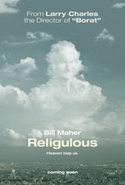
Religulous Gets the Laughs

Last Friday (October 3rd), a friend and I went to see Bill Maher’s new movie Religulous. It wasn’t showing locally, so we had a forty minute drive to get to a decent theater and we got there well ahead of time to make sure we weren’t thwarted by crazy crowds of Friday-night movie-goers. We had both been eagerly awaiting this movie for months and had very high expectations.

I’m happy to say that my expectations were easily met and even somewhat exceeded. From what I had understood about the movie from reading reviews and interviews, Maher was going for laughs. He was under no delusions that he would be coverting the “faithful” or changing peoples’ minds about their religious beliefs. He hit the nail on the head. Almost from the first minute, the whole audience was laughing. It kept on that way until about the last five minutes of the movie when the tone got more serious (but fitting) for the conclusion.

Maher is very deliberate to point out that he doesn’t describe himself as an atheist, which he defines as someone who knows God doesn’t exist. He says he is a doubter, since nobody can be sure one way or the other. However, what he is scathingly critical of is the unwavering faithful belief in something for which there is no evidence and which amounts to downright absurdity in many cases.

Thoughout the movie, he is extremely adept at pointing out these absurdities in many religiously cherished, irrational beliefs. For the most part, he simply asks questions in a variety of interviews with people from around the world. Most of his actual commentary comes in the form of video outtakes or in monologues delivered while travelling between interviews. Almost all the people he interviews are good natured and are happy to answer his questions. There are a few tense moments with a couple interviewees, but nothing major.

His simple questions and “what about this” scenarios do a great job at exposing the irrationality of religion… with hilarious effect. Whether he’s questioning Christianity, Judaism, Islam, Scientology, or Catholicism, he gets great laughs and even some of his interviewees join in the merriment. It’s a light-hearted journey for such a globally serious topic.

Maher will surely offend those who hold dear those same irrational beliefs that he amusingly questions, but for the rest of us, it’s a delight. I’ve even read some comments by people who have a great dislike for Maher, and even they enjoyed the movie. Of course, those who align with his beliefs will be the most appreciative of his religious mocking and it’s that crowd that will stay with him at the end of the movie when the tone gets serious, calling for an end to irrational, dangerous, dogmatic beliefs before it’s too late.

I stayed with him.

Sam Harris on Sarah Palin and Elitism

In an editorial by Sam Harris, this passage really struck me.

Ask yourself: how has “elitism” become a bad word in American politics? There is simply no other walk of life in which extraordinary talent and rigorous training are denigrated. We want elite pilots to fly our planes, elite troops to undertake our most critical missions, elite athletes to represent us in competition and elite scientists to devote the most productive years of their lives to curing our diseases. And yet, when it comes time to vest people with even greater responsibilities, we consider it a virtue to shun any and all standards of excellence. When it comes to choosing the people whose thoughts and actions will decide the fates of millions, then we suddenly want someone just like us, someone fit to have a beer with, someone down-to-earth—in fact, almost anyone, provided that he or she doesn’t seem too intelligent or well educated.

The rest of the editorial expressed similarly thought-provoking views, but this one specifically caught my attention because the whole idea of “anti-intellectualism” has been on my mind lately, especially with regard to religion and politics.

Here’s the link to the entire editorial: http://www.newsweek.com/id/160080/

I’m done deciding.

My mind has been made up. I’ve decided who I’m going to vote for in the presidential race. Obama. The deciding factor? Sarah Palin.

When I hear this from Palin…

Pray for our military men and women who are striving to do what is right, also, for this country, that our leaders, our national leaders, are sending [Soldiers] out on a task that is from God. That’s what we have to make sure that we’re praying for, that there is a plan and that that plan is God’s plan.

…and this…

I can do my part in doing things like working really, really hard to get a natural gas pipeline, a $30 billion dollar project that’s going to create a lot of jobs for people in Alaska, and we’re going to have a lot of energy flowing through here — and pray about that also — I think God’s will has to be done in unifying people and companies to get that gas line built, so pray for that.

…and…

But really, all that stuff doesn’t do any good if the people of Alaska’s heart isn’t right with God.

…it sickens and enrages me at the same time.

I’ve had way too much of leaders basing their views and policies on religion rather than logic and common sense. The views expressed by Palin and Bush about Iraq aren’t even a step away from a “Holy War” or a “Jihad.” That’s what they’re actually claiming that the war IS. I’m sure they’d claim that there’s a difference, but based on what they’re saying, there isn’t.

Having religious beliefs is one thing. Foisting those beliefs upon a country you lead is hugely different. Creating national policies based on your religious beliefs is hugely different. Leading a country into a war based on your religious beliefs is hugely different.

Enough is enough. I’ve had more than enough.