The How and Why of Denialism

From evolution to vaccinations to global warming, something I encounter on a regular basis on television and the internet is denialism, rejecting the scientific evidence in favor of an alternative… an alternative which could be anything from pure woo to scientific-sounding arguments: “Just have faith” to “irreducible complexity.” Denialism is something that invariably causes a collective sigh an eye roll from the skeptic community because logical and fact-based responses seem to have no effect on denialists.

An article from the European Journal of Public Health defines denialism as “the employment of rhetorical arguments to give the appearance of legitimate debate where there is none, an approach that has the ultimate goal of rejecting a proposition on which a scientific consensus exists.” The article goes on to identify five common characteristics of denialism. I’ve seen all of these “in the wild,” but items one through three are the ones I see most often.

These five characteristics were summarized by Debora MacKenzie in a New Scientist opinion piece titled Living in denial: Why sensible people reject the truth and are as follows:

  1. Allege that there’s a conspiracy. Claim that scientific consensus has arisen through collusion rather than the accumulation of evidence.
  2. Use fake experts to support your story. “Denial always starts with a cadre of pseudo-experts with some credentials that create a facade of credibility,” says Seth Kalichman of the University of Connecticut.
  3. Cherry-pick the evidence: trumpet whatever appears to support your case and ignore or rubbish the rest. Carry on trotting out supportive evidence even after it has been discredited.
  4. Create impossible standards for your opponents. Claim that the existing evidence is not good enough and demand more. If your opponent comes up with evidence you have demanded, move the goalposts.
  5. Use logical fallacies. Hitler opposed smoking, so anti-smoking measures are Nazi. Deliberately misrepresent the scientific consensus and then knock down your straw man.

MacKenzie also adds a sixth characteristic.

Manufacture doubt. Falsely portray scientists as so divided that basing policy on their advice would be premature. Insist “both sides” must be heard and cry censorship when “dissenting” arguments or experts are rejected.

In the New Scientist piece, MacKenzie looks at the “why” of denialism.

This depressing tale [about swine flu] is the latest incarnation of denialism, the systematic rejection of a body of science in favour of make-believe. There’s a lot of it about, attacking evolution, global warming, tobacco research, HIV, vaccines – and now, it seems, flu. But why does it happen? What motivates people to retreat from the real world into denial?

Her approach uses a softer glove than many skeptics use, avoiding outright condemnation of deniers but instead making an attempt to understand how denialism spreads: identifying common characteristics, tactics (above), causes, motives, and possible solutions.

The most notable common characteristic that MacKenzie defines is this.

All [denialists] set themselves up as courageous underdogs fighting a corrupt elite engaged in a conspiracy to suppress the truth or foist a malicious lie on ordinary people.

I can anecdotally confirm that statement, both in my personal life and in my readings.

Where MacKenzie goes after that is to a hypothesis that what really triggers denialism is a sense of loss of control… a hypothesis that seems a good fit to the major denialist issues.

It is this sense of loss of control that really matters. In such situations, many people prefer to reject expert evidence in favour of alternative explanations that promise to hand control back to them, even if those explanations are not supported by evidence

All denialisms appear to be attempts like this to regain a sense of agency over uncaring nature: blaming autism on vaccines rather than an unknown natural cause, insisting that humans were made by divine plan, rejecting the idea that actions we thought were okay, such as smoking and burning coal, have turned out to be dangerous.

She goes on to explain that this position is not necessarily malicious or anti-science. They simply require a human reaction.

It only requires people to think the way most people do: in terms of anecdote, emotion and cognitive short cuts. Denialist explanations may be couched in sciency language, but they rest on anecdotal evidence and the emotional appeal of regaining control.

The origins of denialist claims are another matter, and MacKenzie talks about how many of the more prominent claims (tobacco, global warming) got their start with corporate backing, how deniers tend to attract other deniers, and how claims become politically and religiously charged.

The European Journal of Public Health article isn’t as philosophical in its analysis of denialist motivations, but hits home nonetheless.

Denialists are driven by a range of motivations. For some it is greed, lured by the corporate largesse of the oil and tobacco industries. For others it is ideology or faith, causing them to reject anything incompatible with their fundamental beliefs. Finally there is eccentricity and idiosyncrasy, sometimes encouraged by the celebrity status conferred on the maverick by the media.

Whatever the motivations (personal, political, financial, etc), the one thing that remains true among denialist claims is their distortion (or complete rejection) of the truth. For many issues, such as vaccinations and global warming, denialism has caused and will cause lives to be lost. For others, such as the rejection of evolution, their positions simply contribute to the “dumbing down” of America.

The frustration of dealing with most deniers is the almost impenetrable armor of ignorance they wear which deflects attempts at presenting actual evidence, be it factual or logical. They counter by trotting out any of the tactics listed at the beginning of this article, selecting the one that best fits the topic at hand. Cherry pick this evidence. Trot out this fake expert. Rage about this conspiracy theory.

When all else fails, bring up Hitler.

(h/t)

A Better Approach

At the beginning of last month, I wrote about the Freedom From Religion Foundation‘s sign at the Olympia, Washington capitol building, stating that I wasn’t all that pleased with the approach they took with the wording of the sign. Since then, I’ve read a lot (and I mean a lot) of commentary about that situation and have decided two things.

First, I think the point of displaying the sign wasn’t to further atheism, per se, but was more to demonstrate the point that government buildings shouldn’t be hosting religious displays of any kind. Not only was the FFRF’s sign displayed, but because of the “open door” policy required due to the Alliance Defense Fund’s lawsuit, there were displays requested  for other “religions” as well (Pastafarianism, Festivus) including an application by the Westboro Baptist Church to put up a sign declaring that “Santa Claus Will Take You To Hell.” It turned into quite a fiasco which, to anyone who wasn’t too incensed to miss the point, demonstrates in grand fashion just why religious displays have no place in government buildings.

Second, I still don’t think it was the best approach. FFRF’s stated goals are (from their bylaws) “to promote the constitutional principle of separation of state and church, and to educate the public on matters relating to nontheism.” I think both of those goals are admirable and could have been accomplished in a way that would have brought far less scorn to atheists.

I read this article today by David Gleeson (who has a similar view about the situation) and was impressed with his suggested alternate message.

At this season, may reason triumph over fear and superstition, and may we renew our commitment to life, love, and the bonds of our shared humanity.

That’s good stuff.

David makes a number of other good points in his article as well and I especially agree with him about the absolute statements in the FFRF’s sign. Dan Barker of the FFRF should know better. Lack of evidence does not necessarily mean lack of existence. It might. It might not. We don’t know and we cannot possibly know… for certain. Claiming to know with certainty cripples us in the same faith-based trap as religion. Based on the evidence (or lack thereof in this case), I can believe there is no god, but I cannot know there is no god.

So David’s softer, more positive message is a winner in my book. I think it would have been a much better approach. It  probably still would have stirred up enough controversy to make the “separation of church and state” point, but it would have done it without putting another black mark on atheists.

Why the Blind Support?

Palestinian RubbleI have to admit that I don’t understand. I haven’t understood for a long time.
Why… why does the US always blindly support Israel no matter what it does?

Now don’t get me wrong. I’m certainly not suggesting that the actions of Hamas and the Palestinians have been any great representation of moral superiority… far from it… but Israel certainly is no better. I’ve heard people say that Israel is just protecting itself from Palestinian aggression, but the same has been said of the Palestinians (who certainly seem to have body count on their side of the argument).

Palestinians seem to have a reprehensible tendency to employ suicide bombings and somewhat random missile attacks (for which I’ll blame Hamas) which tend to predominantly kill and injure Israeli civilians. Israel tends to employ more targeted all-out military actions that kill dozens if not hundreds of Palestinians (including some civilians) and destroy buildings and homes with wanton abandon.

I cannot see how either antagonist in this conflict can, in good conscience, be supported, yet the United States continually and unequivocally sides with Israel. Yes, some officials call for bilateral cease fires and there are numerous impotent “peace plans” suggested and implemented, but all of them start from the assumption that Israel is the victim and deserves our unquestioning and unwavering support.

I fully admit that I am not as well versed in history as I could be in this matter, however I’ve been paying attention to the situation for some years now and I find both sides to be despicable. The history that I do know tells me that this entire situation is a petty religious conflict that has little to no possible chance of being resolved peacefully. Nor does it have a chance of being resolved militarily.

So why the support for Israel? Is it political fear of being painted as an anti-semite? Is it some sense of misplaced duty to uphold a 1947 United Nations resolution? Is it the lack of other allies in the region? Is it some ancient Biblical text promising the land to the Jews? I just don’t get it.

I’ve seen, read, and heard nothing that would justify the blind support of a country whose actions are just as disgraceful as those of their enemy.

Religulous Gets the Laughs

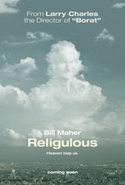
Last Friday (October 3rd), a friend and I went to see Bill Maher’s new movie Religulous. It wasn’t showing locally, so we had a forty minute drive to get to a decent theater and we got there well ahead of time to make sure we weren’t thwarted by crazy crowds of Friday-night movie-goers. We had both been eagerly awaiting this movie for months and had very high expectations.

I’m happy to say that my expectations were easily met and even somewhat exceeded. From what I had understood about the movie from reading reviews and interviews, Maher was going for laughs. He was under no delusions that he would be coverting the “faithful” or changing peoples’ minds about their religious beliefs. He hit the nail on the head. Almost from the first minute, the whole audience was laughing. It kept on that way until about the last five minutes of the movie when the tone got more serious (but fitting) for the conclusion.

Maher is very deliberate to point out that he doesn’t describe himself as an atheist, which he defines as someone who knows God doesn’t exist. He says he is a doubter, since nobody can be sure one way or the other. However, what he is scathingly critical of is the unwavering faithful belief in something for which there is no evidence and which amounts to downright absurdity in many cases.

Thoughout the movie, he is extremely adept at pointing out these absurdities in many religiously cherished, irrational beliefs. For the most part, he simply asks questions in a variety of interviews with people from around the world. Most of his actual commentary comes in the form of video outtakes or in monologues delivered while travelling between interviews. Almost all the people he interviews are good natured and are happy to answer his questions. There are a few tense moments with a couple interviewees, but nothing major.

His simple questions and “what about this” scenarios do a great job at exposing the irrationality of religion… with hilarious effect. Whether he’s questioning Christianity, Judaism, Islam, Scientology, or Catholicism, he gets great laughs and even some of his interviewees join in the merriment. It’s a light-hearted journey for such a globally serious topic.

Maher will surely offend those who hold dear those same irrational beliefs that he amusingly questions, but for the rest of us, it’s a delight. I’ve even read some comments by people who have a great dislike for Maher, and even they enjoyed the movie. Of course, those who align with his beliefs will be the most appreciative of his religious mocking and it’s that crowd that will stay with him at the end of the movie when the tone gets serious, calling for an end to irrational, dangerous, dogmatic beliefs before it’s too late.

I stayed with him.

Sam Harris on Sarah Palin and Elitism

In an editorial by Sam Harris, this passage really struck me.

Ask yourself: how has “elitism” become a bad word in American politics? There is simply no other walk of life in which extraordinary talent and rigorous training are denigrated. We want elite pilots to fly our planes, elite troops to undertake our most critical missions, elite athletes to represent us in competition and elite scientists to devote the most productive years of their lives to curing our diseases. And yet, when it comes time to vest people with even greater responsibilities, we consider it a virtue to shun any and all standards of excellence. When it comes to choosing the people whose thoughts and actions will decide the fates of millions, then we suddenly want someone just like us, someone fit to have a beer with, someone down-to-earth—in fact, almost anyone, provided that he or she doesn’t seem too intelligent or well educated.

The rest of the editorial expressed similarly thought-provoking views, but this one specifically caught my attention because the whole idea of “anti-intellectualism” has been on my mind lately, especially with regard to religion and politics.

Here’s the link to the entire editorial: http://www.newsweek.com/id/160080/